
By Sumit Manwal, Founder, Hospitality Vacancy
Abrasives remove stubborn soil by friction, and can scratch surfaces just as easily.
Here is how to use them wisely.
Studying hotel management or starting your first hotel job? Create your free candidate profile on Hospitality Vacancy and browse hotel jobs by department while you learn.
These are substances or chemicals that depend on their rubbing or scratching action to clean dirt and grit from hard surfaces. They are used to remove very stubborn stains on various surfaces.
Abrasives are classified as
Talc Calcite Feldspar Diamond
Scale of hardness
Fine abrasives – These include precipitated whiting (filtered chalk) and jeweler’s rouge (a pink oxide of iron) used for shining silver. They are also constituents of commercial silver polishes.
Medium abrasives – These include rotten stone, salt, scouring powder and scouring paste. Scouring powders are made up of fine particles of pumice mixed with a soap/detergent, an alkali and a little bleach.
Hard/coarse abrasives – These include bath bricks, sand paper, pumice, steel wool and emery paper.
Glass paper, calcite, sand paper, fine ash, emery powder and paper, jeweler’s rouge, powdered pumice, precipitated whiting (filtered chalk), feldspar, ground limestone, sand, carborundum, steel wool and nylon scourers are some commonly used abrasives.
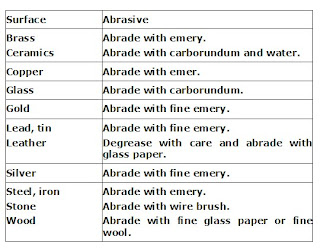
Abrasives are usually not used alone in cleaning agents. For example, cream or paste meant for cleaning utensils contains about 80% of finely ground limestone, along with other substances such as bleachers, anionic surfactants, alkaline builders and perfumes. The use of various abrasive agents for cleaning different surfaces is summarized in above table
Manwal
FAQ
When should abrasives be avoided?
On glass, polished metals, plastics, enamel and other delicate finishes.
Your next step
- Students and hotel professionals: Create your free candidate profile on Hospitality Vacancy and browse the latest hotel jobs.
- Want personal guidance? Book a Hotel Career Guidance Call (30 min) and we will plan your next step together.
- Hotels hiring: Register as an employer on Hospitality Vacancy.
Related reading on this blog
- Abrasive Cleaners: Grades and Safe Use
- Alkalis as Cleaning Agents: Uses, Examples and Safety in Housekeeping
- Reagents as Cleaning Agents in Housekeeping
About the Author
Sumit Manwal is the founder of Hospitality Vacancy (since 2017) and has 20+ years of experience in hospitality. He received the "Excellence in Hospitality Sector of Uttarakhand" award, presented by Shri Dhan Singh Rawat ji (January 2023), and the Dainik Jagran inext Uttarakhand Ratan Samman for Excellence in Hospitality & Education, presented by Shri Bhagat Singh Koshyari ji (2023). He helps hotels build reliable teams and professionals grow their careers.
📧 Contact: manwal@hospitalityvacancy.com | 🔗 LinkedIn
Please do not enter any spam link in the comment box